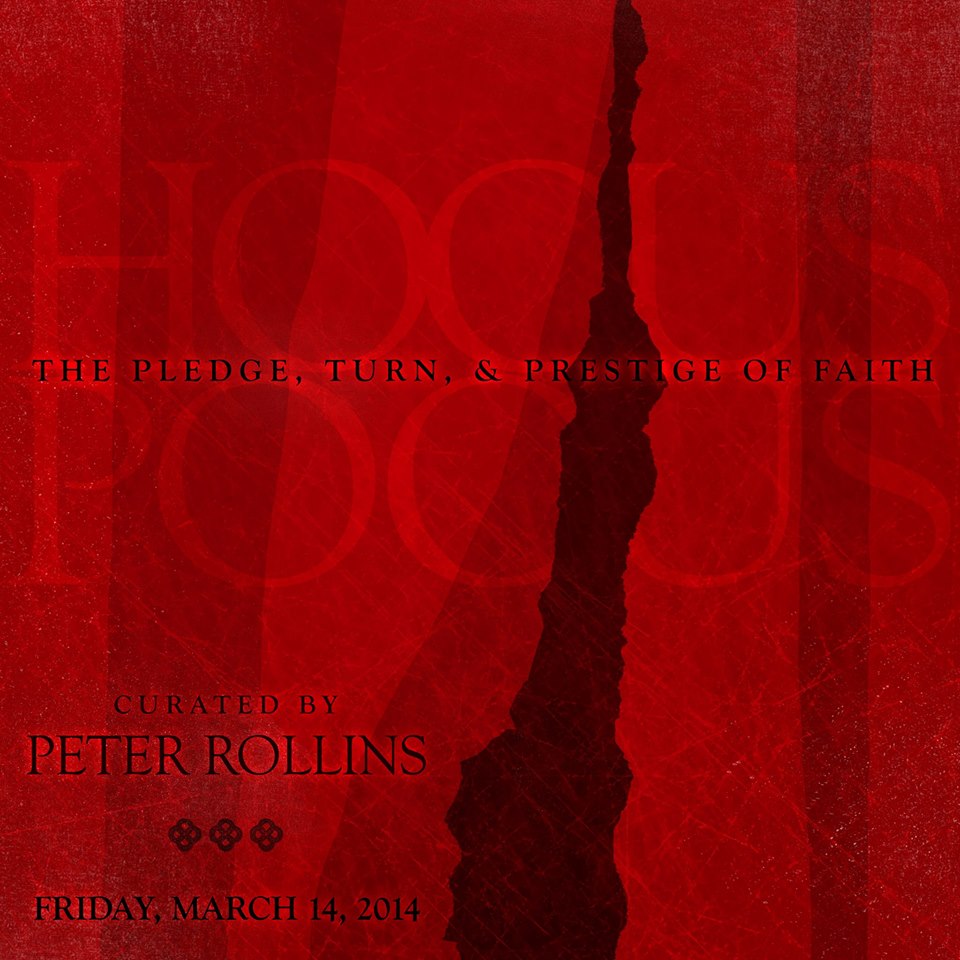
Background: Last weekend, I was at “Hocus Pocus: The Pledge, Turn, and Prestige of Faith” with Peter Rollins and others. This was only the most recent of my explorations of our changing ecclesiology, but prompted me to offer these reflections.
It’s no secret that the nature of church is changing. With it, the faces of Christianity and the Christian life are also changing. In order to help prepare the way for what God might be doing in the world, I have been reading a lot about these changes and what it might mean for the church going forward. In so doing, I have encountered the work of several young(-er,-ish) theologians that are wrestling with what it means to be a Christian and what it means to be church in this era (see list at foot of this article).
Many of these theologians are pretty radical (in both meanings of the word: 1. very edgy or far beyond the norm; and 2. pertaining to or directly proceeding from the root) — they are all thought provoking and stimulating. Most of these voices originated in the evangelical community… many were Fuller grads (my alma mater). They would appear to be moving to a more progressive stance, but still very rooted in scripture,the person of Jesus and the gospel (though they might describe the good news in ways that are different than the traditional ones).
While these authors have diverse viewpoints, I am discovering some common themes that we might consider as we seek to be faithful into the future. I have attempted to give expression to those themes below.
THEMES
- Christ and Scripture are more important than tradition or any particular theology.
- Doubt is not weakness but rather an act of deep faith that can break us open to a deeper encounter with God and expose our idols (any certain theology can become ideology, which can then become idolatry)
- This generation often experiences the church as false,shallow and unreal: while we say that we love others, we exclude some; while we say that doubt is normal, our liturgy is normed around certainty (thus dodging the truly transforming nature of the crucifixion). Voicing a common theme, Rob Bell notes that he had to go to a 12-step group to be in a “bull shit free zone” [his words, not mine!] and to experience a faith that was more faithful/real/genuine.sincere/deep
- Need to address and embrace angst honestly — we need to make friends with uncertainty, insecurity, etc.
- There is a renewed appreciation for spirituality that is mystical (both kataphatic and apophatic) as opposed to intellectual.
- There is a desire for theological dialogue that is not driven by any particular theological view. I see this as more of a discernment model of pedagogy and formation rather than a cognitive or content based pedagogy.
- Scripture is viewed as a poly-valent narrative. Consequently, systematic theology is on the wane, in favor of narrative, heuristic and mystical theologies.
- There is a strong focus on the here and now and how we live as disciples in this world (in contrast to focus on our eternal destiny). Thus, social justice and social engagement are important aspects of the life of faith.
- The church needs to hold its theologies and ideologies lightly and to develop a posture of conviction and deep humility.
- These theologians are non-dualistic; there is no sacred/secular divide. In fact the “secular” world (such as the arts) are often sources of revelation and contributors to our conversion/transformation.
- Membership is replaced by discipleship. Christians are first and foremost missionaries- moving out from the church to engage the world with the gospel. (Rather than trying to draw people into the church.)
These themes are simultaneously exciting, threatening and puzzling for me, and perhaps for you. Yet, I am convinced that God is up to something and that it is important for us to be attentive to God’s word to us in all of this. Next week, I’ll post some of my thoughts about if/how these themes might intersect with my denomination (the PCUSA), but in the meantime, I’d be interested to hear your thoughts about these themes, so bring it on!
Bibliography:
Gabe Lyons – The Next Christians: Seven Ways You Can Live the Gospel and Restore the World
Nadia Bolz-Weber: Pastrix: The Cranky, Beautiful Faith of a Sinner & Saint
Rob Bell: What We Talk About When We Talk About God
Peter Rollins: How [Not] to Speak of God
Peter Rollins: The Idolatry of God: Breaking Our Addiction to Certainty and Satisfaction
Peter Rollins: Insurrection: To Believe is Human; To Doubt,Divine
Richard Rohr: Things Hidden: Scripture as Spirituality
Derek Flood: Healing the Gospel: A Radical Vision for Grace, Justice, and the Cross
Elaine Heath: The Mystic Way of Evangelism
Barbara Brown Taylor: Leaving the Church
Peter Block: Community
Michael Frost and Alan Hirsch: Re-Jesus
Alan and Debra Hirsch: Untamed: reactivating a missional form of discipleship
Alan Hirsch ad Lace Ford: Right Here Right Now
Bob Ekblad: Reading the Bible with the Damned; A New Christian Manifesto: Pledging Allegiance to the Kingdom of God
Phylllis Tickle: The Great Emergence
Ryan Bell: http://www.patheos.com/blogs/yearwithoutgod/about/


 Thoughts & Images from the Heart