Guns and Church

NOTE:  Just as I was preparing to post this, the news breaks that there has been a shooting of six people at a FedEx facility in Kennesaw, GA.  This follows a campus lock-down at Kennesaw State University last week when there was fear of a shooter on campus. It does seem that we deal with this issue more and more.  How can or should the local congregation respond?  How can we offer the “fear not” of our Savior to our local communities?  I was raised in a family that includes a lot of hunters and gun-owners, so I believe that guns do have some proper uses.  However, the rise in open and concealed weapons in public suggests two things:  1) that we do not feel like we do not trust the rule of law in our country to protect us; and 2) we do not trust in God to protect us.  I acknowledge that good and faithful people may disagree with me, but I do think that the faith community needs to wrestle with this issue theologically and practically so that the Lord’s “peace be with you” may be shared and known in our local communities.  


This month, our governor (Nathan Deal) signed legislation that expanded the places where citizens can carry concealed weapons.  The expanded areas include bars, churches, school zones, government buildings and some parts of airports.  The new law becomes effective on July 1.  The law does permit that churches (and certain other property owners) can make their own determination as to whether or not they want worshipers to carry guns.

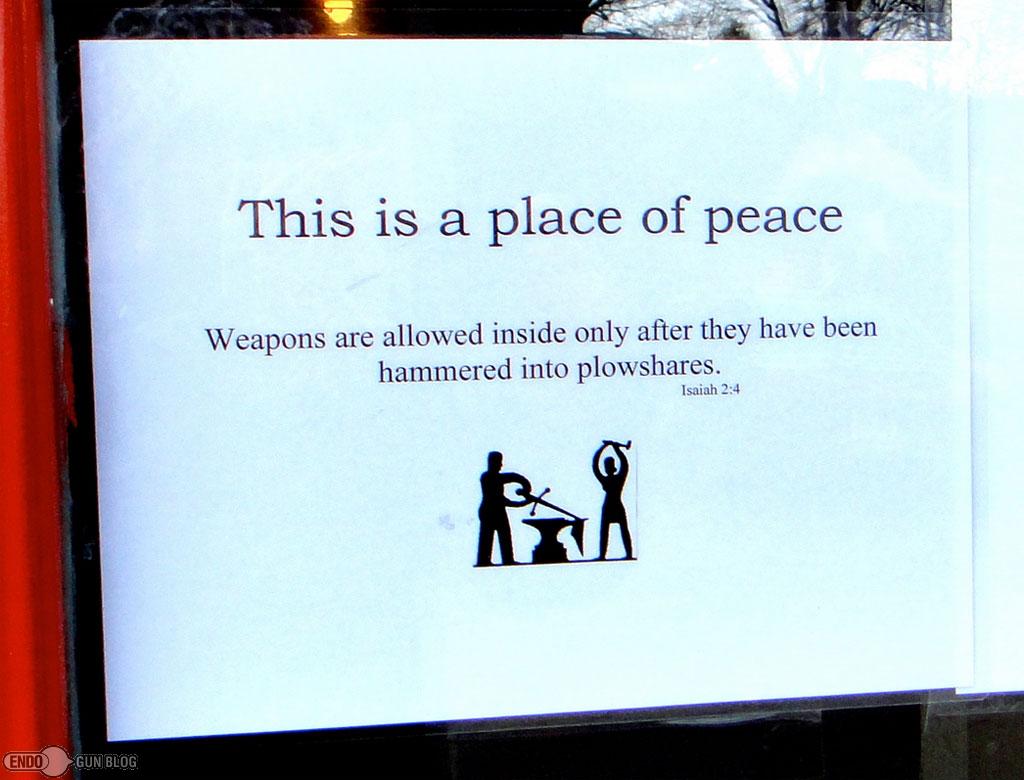
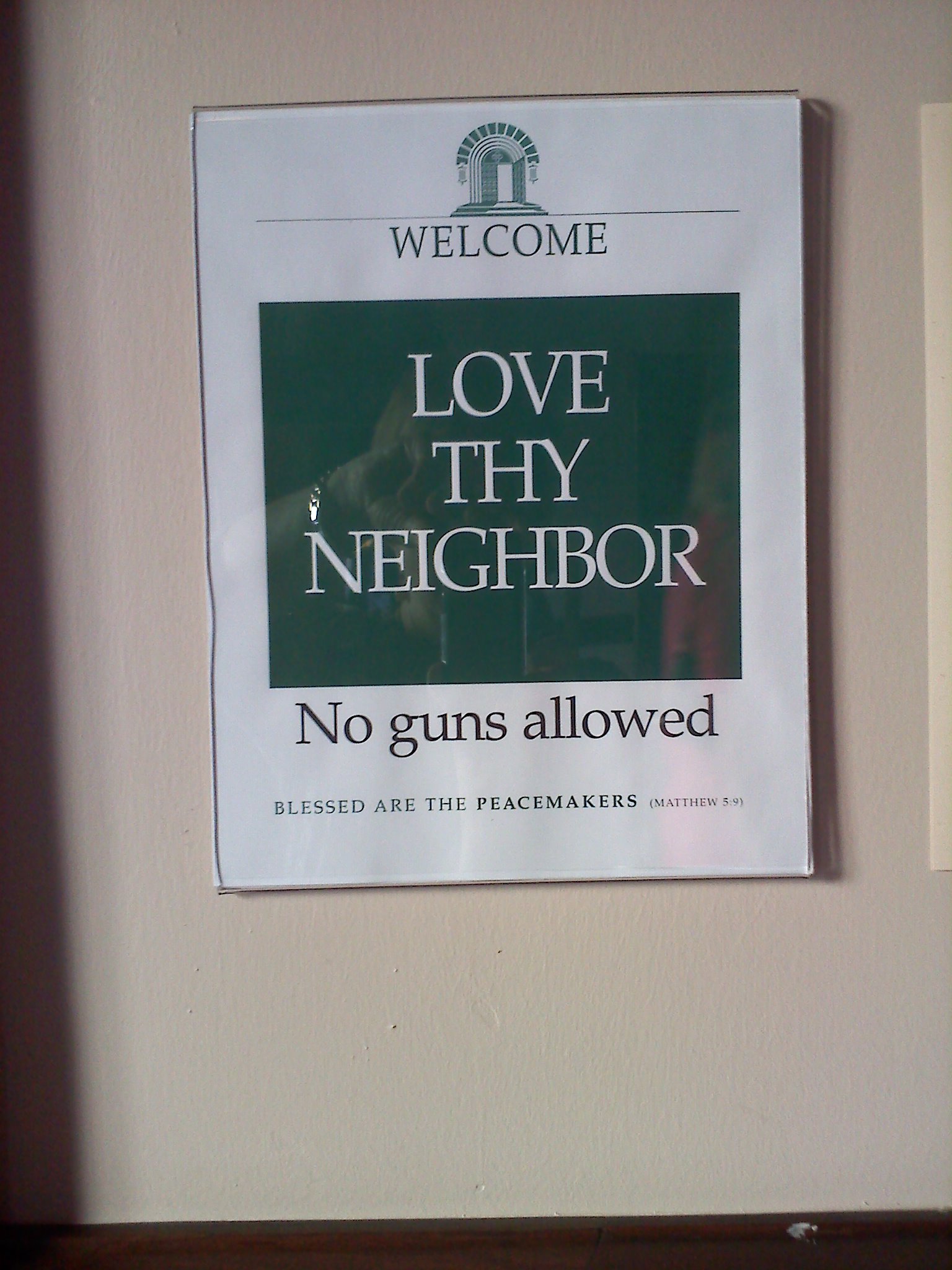
Persons of good faith have diverse opinions on the extent to which “the right to bear arms” should go.  Even so, it does make sense for church sessions to think theologically about the use of weapons and about how this new law impacts their places of worship.  I have searched the internet and found some “polite” and/or amusing ways to get a no-guns policy point across.  A few of these are below to help you think about how you wish to deal with this issue and then how you wish to share you policy with visitors and members.


sign_large

http://news.minnesota.publicradio.org/features/2004/07/13_khoom_concealedcarry/
 

No-Weapons-Allowed-In-Church

http://althouse.blogspot.com/2012/02/weapons-are-allowed-inside-only-after.html
 

No guns in church

Photo taken by RMB at Presbyterian Church in Minneapolis, MN


But seriously, if you truly don’t want guns on your premises, you will probably need something that will be enforceable (perhaps along with something humorous) such as the following:

No Guns Sign

I would be interested to know how your sessions chose to deal with this issue, so let me know!

Additional Resources

Downloadable Study on Gun Control:  http://www.thethoughtfulchristian.com/Products/TC0057/gun-control.aspx

Gun Violence Prevention:  http://www.pcusa.org/resource/guns-us-today/

Litany on Gun Violence:  http://www.pcusa.org/resource/litany-tragedy-gun-violence/

Film:  Trigger: The Ripple Effect of Gun Violence  http://triggerdoc.com/

Presbyterian Disaster Assistance Resources:  http://www.presbyterianmission.org/gunviolence/

 

Invitation to Easter Life

tomb entrance

I called through your door,

“The mystics are gathering

in the street.  Come out!”

“Leave me alone.

I’m sick.”

“I don’t care if you’re dead!”

Jesus is here, and he wants

to resurrect somebody!”

                ~Rumi (transl. Coleman Barks)

Reflections on Maundy Thursday

After a day at work, I returned home to the assisted living facility where I share a room with my husband and two poodles feeling a bit guilty.  You see, I had been caught between the guilt of missing a Maundy Thursday service at one of our congregations and the guilt of not spending time with my ailing husband.  I had finally landed on spending the evening at home with him, but was still feeling a bit guilty… what kind of way was this to remember the last supper?

But Maundy Thursday managed to find me, even buried as I was in assisted living.  You see, after supper, I agreed to help a friend here that is stricken with Parkinson’s.  Her family had suffered the death of two people yesterday and she needed help to write the sympathy cards, so I offered to be  her scribe.  She and I sat at a table in the TV room with another lady. Soon, another resident , “E,” entered the room wearing her nightgown, quite agitated and afraid (this woman has dementia of some sort, and is often treated harshly by some residents because of her neediness).  The ladies at my table encouraged E to join us, so with great difficulty, she sat at the table.  Soon my husband, “W” (also with dementia) came in and was confused and wanting to talk.  He wound up at the table as well.  The conversation evolved into a profound but almost comical round of card-writing dictation, interspersed with frightened questions and words of comfort/advice.   I realized that we were “washing one another’s feet,” disabled, uncertain and confused as we all were.

Even though I wasn’t at church, I knew Jesus was smiling.

footwashing


Holy Fools

Note:  This sermon was written several years back, when Palm Sunday fell on April 1st.  Though today is not April Fool’s Day, I think the sermon still stands.  


 jones jesterJester
By Michele Jones

Today is April Fool’s Day, and what better day to celebrate God’s Holy Fool:  Jesus the Christ?


A ‘holy fool’ is a person who sees what’s really going on in society and has the audacity to say it, but only in a kind of code.  If there’s a crooked government, the holy fool will maybe perform a weird pantomime or tell a story, one that gets everyone to laugh at first; sooner or later, the more perceptive members of the …audience will recognize in the fool’s antics a hidden message. Stating this message in code is protection against the wrath of the authorities.”[1]


Jesus wasn’t the first holy fool… oh, no.  Jeremiah (who paraded through town with an ox’s yoke around his neck), Hosea (who clung to a publicly and blatantly unfaithful wife), and Ezekiel (who maintained silence for months, lay bound in the dirt, and more) were also such fools.


Nor was Jesus the last of the Holy Fools.  From the apostle Paul, who often portrayed himself as a befuddled orator, to St. Francis who stripped naked and ran through his home town, to assorted artists and performers, Jesus was most certainly NOT the last.


By their coded stories and parables — with their outlandish behavior, these fools for God exposed the demonic standards of the Kingdom of this World and also exposed the sins of God’s people.  Being a Holy Fool is a dangerous and subversive calling.


If you think about it, Jesus’ entire career could be viewed in terms of the Holy Fool.  His sayings and his parables stood conventional wisdom on its head:  “If you seek to save your life, you will lose it, but if you lose your life, you will save it.”  “Blessed are the poor.”  It was not just his words, but also his actions:  He befriended the poor, he ate with sinners.  He behaved outlandishly, in the temple – turning over tables, he disrespected the Sabbath with his works of mercy and compassion.


On the Sunday before Passover, Jesus the Fool kicked it up a notch.


Now, everyone loves a parade.  Civic parades like those on the Fourth of July and the New Year’s  Rose Parade are lots of fun.  They are filled with floats and marching bands, dignitaries and famous people waving to the crowds from fancy convertible cars.


But there are also military parades.  Military parades are different… they are meant to comfort the people in power and to intimidate those over whom they have power or those who might be thinking of threatening them.  We’ve all seen movies of military parades in the old Soviet Union, with line upon line of spiffy soldiers, followed by an intimidating number of tanks and weapons.


Kings and conquerors in the ancient near east made great use of military parades.  After a successful battle the leader of the army entered the town in a chariot, flanked with lines of soldiers, in a major display of might.  A military parade meant to display the conqueror’s strength and power.  It was also meant to strike fear into the hearts of those who were the conquered, and thus thwart any notions of rebellion.


In first century Israel, the Roman government always made a show of force during the Jewish celebration of Passover (when they recalled and celebrated their political liberation from Egypt centuries before).  This was meant to remind the people of who was really in charge, and to convince them that God’s saving acts were merely quaint and touching stories from the past.  So on one particular Passover week, Jesus, the Messiah, decides to enter Jerusalem in a political parade of his own.


So how did King Jesus choose to enter Jerusalem?  He came riding on a donkey…a donkey!  The equivalent of a tiny clown car!  Jesus’ parade was an amazing parody of the military parade happening across town.  The crowd that followed Jesus got caught up in the street theatre of it all, and began to throw their coats and palm branches in the street in honor of THIS king.


After their initial laughter of derision, the political and religious officials caught the mockery of this demonstration – they decoded the message and knew it was poking fun at them.  THIS king displays gentleness rather than might, simplicity rather than a flashy parade of wealth.  He does not seek self-aggrandizement and ceremony, but seeks to serve others.  This Messiah would not be a military messiah, nor would he give the temple authorities broader political power.  This was bad enough, but when the crowd joined into the parade, the glitterati began to sense the danger of it all.  Thus began the steady movement toward Good Friday.  The parade of Palm Sunday led to Jesus’ crucifixion on a cross.


The first followers of Jesus also played the Holy Fool, and, like him, they paid the price.  They did not conform to the world’s paradigms, but lived in such a way that the powers of this world were challenged and undermined.  They began to transform the world by upsetting the apple cart.  They were called atheists because they refused to participate in Rome’s cult of imperial worship; their communities of service and mutual care were a comical contrast to the society they lived in.


Today, Jesus invites us to join the parade of Holy Fools.  As his followers, do we live in such a way that others see the foolishness of Christ in us, and in so doing, have their eyes opened to the truth?  Or do we live in such a way that we are unremarkable and accepted by others, thus leaving them comfortable in their captivity?


Jesus invites us into the order of the Holy Fool.  In the words of John Wimber, “if you’re not God’s fool, whose fool are you?”  It’s a good question to ponder.


[1] http://saintpaulsunday.publicraido.org/features/0004 _shostakovich/holyfool.shtml

Theological Mash-up, Part 2

Java Printing

Last week, I shared some of my analysis of the Emergent Church voices, noting themes that I detect in the literature and bloggesphere.  This week, I’ve had a few further thoughts and would add the following themes to the previous list:

  • Spiritual formation is as  important as catechesis (if not more so) — in other words, knowing God and living in/with God are perhaps more desirable than knowing about God.
  • A desire for faith that is experiential as well as cerebral; and where each informs the other.


INTERESTING IDEAS

Some ideas were mentioned at the Hocus Pocus event that caught my attention and imagination:

  • Pop up church:  Peter Rollins spoke about doing “pop up” churches… gathering a group together for 1 year and then at the end of the year, be ready to disburse or continue as the spirit leads.  I wonder how this would feel?  Would it free us to be focused on the moment and the task of discipleship/fellowship/service/spiritual formation and not to be concerned with things like budgets, growth plans, membership, etc?  Sounds pretty intriguing.
  • Safe Spaces and other non-church-y gatherings for conversation and personal/spiritual encounters:  The School of Life (see Note 1, below) is one example that many are considering.  My colleagues and I came up with a possible group name:  “The League of Like-able Sinners”


GOOD NEWS FOR THE  PC(USA) —

So what is the PC(USA) to make of all of this?  Is there a role for us to play in the new era?  While there are many things about our present life that might be cumbersome, I do think that there is hope for us, especially if we can reclaim some of our theological heritage.  At our best, Presbyterians have the following things to offer:

  • We acknowledge that God alone is the Lord of conscience.  At our best, we can model how to wrestle with scripture and with one another, living in the tension of differing opinions and still getting along and encouraging one another.  There is a deep hunger for this.  Can we set aside our need to be right and reclaim this way of living together?
  • We know about depravity.  We acknowledge that everything is broken.  Perhaps we might give more room exploring and naming that in our liturgy, our pastoral care and our discipling of one another.
  • We have a strong commitment to the civic life and to social justice.  Can we be bold about that?
  • Idolatry is a big bug-a-boo for us… we KNOW that humans are ever prone to create idols (even of our own understandings and traditions).  Can’t we then embrace and celebrate the doubt and humility that inoculate us against idolatry?


So, there you have it. These are my reflections on what I read and my ponderings toward the future.  As I’ve said before, God is definitely birthing something new in the church.     I don’t know if we’re at morning sickness or at labor pains, but we can definitely feel the stress, strain and discomfort of this new life that is coming.  The question for all of us is this:  will we, like Mary, say ‘yes’ to God’s work in us, even if it seems beyond our understanding of all that is possible or desirable?   We can only hope and pray so.   Have no fear, for if we are silent/reluctant, “the stones would shout out” (Luke 19:40b).   God’s new thing will come to fruition.  Don’t you want to be part of it?  I think I do!


Notes

1.  The School of Life  http://www.theschooloflife.com/ and http://en.wikipedia.org/wiki/The_School_of_Life