A Progressive Feast of Thanksgiving

They say that the most babies are born in August, but apparently more than a few church births happen in the autumn.  Over the next month, we will have three occasions to give special thanks to God — a three-part, progressive celebration of Thanksgiving for Cherokee Presbytery, if you will – as we celebrate three significant church anniversaries and birthdays.

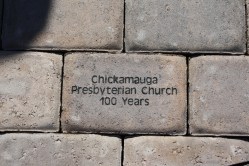
Today marked the first of those events.  A sizeable crowd gathered this weekend to celebrate the 100 year anniversary of Chickamauga Presbyterian Church.  Festivities included an open house and music recital on Saturday and a hymn sing, worship service and celebration dinner today.  Former pastors, George Long, Ken Terrell, William Mills, Edward Langham and Chuck Taber participated in the service, along with current pastor Bridget Waddell and both the adult and children’s choirs.  Chickamauga’s church historian, Janice Maybery Westbrook put together a wonderful written and pictorial history of the congregation and set up a special ‘heritage room’ with many mementos from the 100 years of ministry and service.  (Copies will be sent to Columbia Seminary and to the Historical Society in Philadelphia for preservation.)  And a special anthem, “Our Mission is Jesus,” was written by choir director, Wilma Dalrymple Darnell for the occasion. 
Part two of our progressive Thanksgiving takes place on November 14th as Marietta First Presbyterian Church celebrates their 175th anniversary.  Marietta First is our largest congregation, and the festivities will include an anniversary exhibit (Nov. 3-15) and worship celebrations in all services on the 14th.  Doubtless, Marietta’s long history of worship, service, witness and mission will be inspiring to all who attend.  The congregation is presently served by pastors, John Wells, Denise Beltzner, and Keith Gunter, a host of other staff and a 33 member session.

The third portion of our Thanksgiving will happen on November the 21st at 2pm, as we charter a brand-new congregation — Grace Presbyterian Church in Dawsonville.  This congregation began about five years ago with the leadership of Rev. Mark Weaver and the Tri-Presbytery New Church Development Commission.  They are presently served by transitional pastor, Dana Hughes and a strong team of lay leaders.  Though they’ve been a ‘church’ for all this time, on November 21st, they become an official, established congregation of our denomination.  Hooray!

For congregations new and old, we truly give thanks to God and to the many faithful servants of Christ who nurtured them along the way.  May each of these remarkable congregations continue to grow in faith and service to our Lord.  Amen.

The Spiritual Disicpline of Body Work

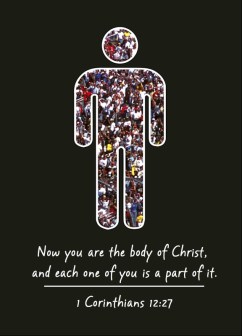
Let’s be clear from the start… I’m an introvert. I enjoy (some might say even say I crave) solitude… time alone to pray, think and mull.  Therefore, the community nature of the Body of Christ can be a stretch for me… in a “spiritual discipline” kind of way.

Our Lord and the apostles exhort us to be active in “one another-ing” (Gk: allelon).  For example:

  • Love one another;
  • Wash one another’s feet;
  • Live in harmony with one another,
  • No longer pass judgment on one another;
  • Welcome one another;
  • Greet one another with a holy kiss;
  • Care for one another;
  • Become slaves to one another;
  • Teach and admonish one another;
  • Encourage one another;
  • and many more.[i]

Suffice it to say that my introverted nature is deeply challenged by these words, and yet scripture is clear that only together are we the Body of Christ.  Being the Body of Christ is not a solo enterprise, and therefore active participation in the community of faith is critical to our discipleship and our witness.

This truth is perhaps especially important to grasp now, as our denomination is presented with (yet another) opportunity to make changes to our constitution.  Ordinarily I would prefer to study and pray over the issues on my own in preparation for voting.  However, scripture (and our polity) challenge me to join with my brothers and sisters in this process; even – especially –  with those who might see things differently than I.

Thus, I am (reluctantly) grateful to Cherokee Presbytery’s Coordinating Team for the way that they have structured our process for working through the amendments.  They have allowed for various conversations to be held in around the presbytery so that we might engage these issues in the context of relationship and conversation prior to debating and voting.  The hope is that we will participate in these times of conversation, in the spirit of “allelon” – that is to say that we will be:

  • Listening more than talking to one another
  • Seeking to understand more than to convince one another
  • Open to and trusting one another’s faith, faithfulness, wisdom, and understanding.

In other words, this is an invitation for us to crawl out of our shells and join with one another as we seek God’s will for the church.  Perhaps these conversations will not only grant us an opportunity to ‘bear one another’s burdens [of conviction]” (Gal. 6:2) but also to “bear with one another” (Eph. 4:2) as members of one body.

Leaving Her Comfort Zone

[i] You may want to go to http://bible.oremus.org/ and do a word search on NT citations for “one another” for a full list… much faster than Strong’s Exhaustive Concordance, though that would do it as well.

Being the “Fear Not” People

Internet Security.  Homeland Security.  International Security.  Security check-points. 

Though I grew up in the era of “duck and cover” it seems to me that our drive for security, safety and certainty has increased exponentially since September the 11, 2001.  And yet, despite all of our scurrying, deep down I suspect that  we’ve only gained the illusion of safety and security.  We are probably no more safe or secure than we were before… but we are definitely less free.  We have become captive to our fears and (as Jacques Ellul put it) “our  own frantic need of security.”

Scripture repeatedly exhorts us to “be not afraid” and it teaches us that “perfect love casts out fear” and yet so many of us live our lives afraid… afraid of the economy, afraid of terrorists, afraid of political/social/religious change, etc.  All of these are simply ciphers for the fear of death and eternal separation from the source of Life.  But if we believe that Christ has overcome the grave and that truly “nothing can separate us from the love of God,” then what have we to fear?  Perhaps it is time for us to re-examine these articles of faith and let them take hold deep in our psyches and souls so that we can be fearless witnesses in this era of rampant fear.

May our hearts be grasped anew with the knowledge of the awesome power of God’s perfect love that shatters death and breaks down dividing walls.

Tyrants are not to be feared today, but our own frantic need of security is.

Jacques Ellul

There is no way to peace along the lines of safety.

Dietrich Bonhoeffer

See Also:

NY Times Article:  http://www.nytimes.com/2010/09/05/opinion/05kristof.html?_r=1

Beginner’s Mind

This week, I’m attending a continuing education event at Columbia Theological Seminary.  The seminar/workshop is titled “Social Networking Media in Congregations.”  We are particularly exploring how the church can use Blogs, Facebook, Email Marketing tools and Twitter to help connect our members and those who are not yet part of the church to the Source of Life – Jesus Christ. 

While the possibilities are rich and exciting, I have to tell you that the learning curve is STEEP  (especially for people like me who were reared with envelopes, stamps, typewriters and carbon paper).  As I make attempts with the new technology, I find myself getting frustrated — I don’t like not knowing what I’m doing.  I don’t want to look foolish; I don’t want to risk failure.  I want to maintain at least a sliver of the facade of competence.  But if I want to truly learn to maneuver in this new world, I can’t do that.  I have to risk failure, acknowledge my limitations and open myself up to being taught. 

As I was mulling all of this over last night, I was reminded of Jesus’ exhortation to Nicodemus that we must be born anew to enter the kingdom.  I was also reminded of His words about  “going through the eye of the needle” and the need to  “become like a child.”   It seems that (among other things) Jesus is saying that we must be willing to start over, to risk looking foolish, to be vulnerable and teachable if we are to participate in the life and mission of God’s Kingdom. 

So… today as I stumble my way through Tweets, open sourcing, Wikis, “clouds,” Facebook and blogging… I’ll be thinking of it as a spiritual exercise!!! 

Thoughts on Call, Vocation and Ministry


We Presbyterians talk a lot about “call.” In the most immediate sense, call is the call of Jesus to follow him, to be his disciple. As we respond to that call, we will find that the Spirit activates gifts in us such as those listed in Romans chapter 12. John Wimber (founding pastor of Vineyard Christian Fellowship) preferred to call these gifts “gracelets” because they are charisms (the Greek word for grace). These ‘gracelets’ are the way that Christ is most manifest in and through us. I believe that these specific gifts constitute our vocation, or our ministry role no matter where we are. For instance, I may have the gracelet/vocation of teaching, and exercise that in the home, the academy, the factory floor or wherever I find myself. 
 
A second way we use the term “call” is to talk about a specific situation in which we feel God is inviting us to serve, such as when we are “called” to serve on the Board of Deacons, the Session, in a particular congregation, a particular mission or in a particular ministry. This sense of ‘call’ is more time, place and purpose specific than our vocational call. A call to a particular ministry is an invitation to ad-minister our vocational charism in a particular situation, for a specific time and toward a specific goal. 
 
Members of the clergy are used to attending to their call to a particular ministry. We know that no call to a ministry is forever – we are all interims. On occasion, we may sense that God is calling us to shift gears where we are or even sense that God is telling us that we have completed a particular call … we have done what God asked us to do in this place and it is time to move on to the next thing. 
 
A wise colleague once noted that congregations (and Presbyteries), like individuals have a ‘call.’ Each congregation is called into being by God for a particular purpose and task — to serve and witness to a particular community or a particular population.  For the some, the call is continually fresh and vital, but sometimes we may get the sense that we’ve begun coasting, or lost our sense of urgency to serve the community.  This may be a sign that our call to this ministry is completed. If so, the congregation must listen for the next thing that God calls them to. Sometimes God invites us to stay where we are and apply our vocational gifts in a completely new way to a new end, and sometimes God invites us to celebrate the faithful conclusion of a particular ministry and then re-deploy to serve Him in a new place and time. Changes in a call to ministry are not failures… they are signs that we are being responsive to the  movement of the Spirit as God sends us out to bear witness to the gospel and to serve others in Christ’s name.  And that kind of faithfulness is something to celebrate! 
 
Reflection Questions:
1.  What is your (and/or your congregation’s) vocational charism?
2.  Into what ministries has God called you (and/or your congregation)?
3.  How is that ministry going?  Is God calling you to a new thing?