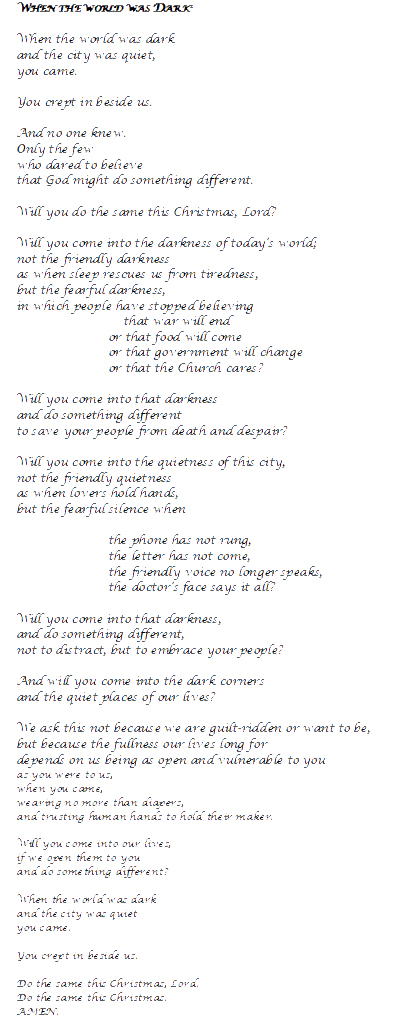
This year, those of us in the northern hemisphere will celebrate Christmas not only in the solar darkness, but in lunar darkness as well.[i]  Somehow this seems fitting.  Whether due to financial circumstances, turmoil in family or church, or illness and loss, many people that I encounter (and sometimes I, myself) feel like they are groping about in a dark and fearful place.  We are overwhelmed, discouraged, fearful, angry… or just deeply sad.  We may find it hard to be in an Advent-Christmas sort of mood – all joyful and expectant – with so much heaviness of heart and mind. 

 It is just to such a place and to people in such condition that the Babe of Bethlehem comes.  And in this, we find our hope… at Christmas time and for each day of the year.   I leave you with one of my favorite Advent prayers.[ii]


[i] The Winter Solstice (or longest night) in the Northern Hemisphere will occur on Dec. 22, 2011.  The New Moon (or Dark Moon) occurs on December 24, 2011.

[ii] a prayer from “Cloth for the Cradle” by the Iona Community Wild Goose Worship Group, 2000

About Time

 ‘So do not worry about tomorrow, for tomorrow will bring worries of its own. Today’s trouble is enough for today.’ ~ Matthew 6:34

What if Jesus wasn’t kidding?

This question was posed by Wayne Muller at the Living Into Sabbath/Guthrie Scholar week I was immersed in this past week.  What if Jesus wasn’t kidding when he said not to worry?

It does seem to me that most of us (myself included) spend alot of time worrying about tomorrow, fretting about what will happen. To our job, our families, our community, our church.

Because we worry about tomorrow, we begin to fixate on the things that are wrong, or things that might go wrong.  We focus on identifying the things that need to be fixed or corrected in order to protect us from unwanted experiences.  Our fear of what might be drives us to all manner of frantic activity and lost sleep trying to ensure that tomorrow will be as it ought to be.

AS IF WE WERE GOD.

We begin to believe that the future depends on us and our ability to keep things moving in the right direction.  And so we are frantic, stressed, anxious,  over-worked and under rested.  If we don’t keep things on course, all will be lost.

REALLY?

Not only does this mindset bring about erosion in our health, suffering in our relationships and division in our communities isn’t it really… well… 

IDOATROUS?

Have we forgotten what we proclaim?  We proclaim that the universe and all that is in it lies in God’s hands.  We say that God is sovereign but act as if we are without hope or help save for our own efforts.  Of course, none of actually  believe that God has left the Universe, and we know that God does desire our  participation in the work of the Kingdom.  Yet, our behavior belies our confidence in God and our willingness to attend to the Spirit for leading.  And so I would propose that we often fall prey to the idolatry of self.  We are self-reliant, self-sufficient, self-important and self-centered.

This week reminded me that a solution for this situation is Sabbath.  A time to step back, even for a day, from running the universe so that we can see that the world turns just fine without our help.  A time to relax, refresh and delight in the life and love that surrounds us.  Time to reconnect with God, creation and  community.  Time to remember what we’ve forgottten.  Time to have ‘enough’ and to be content.  Content!

We spend our lives identifying problems and madly working to create the future that “ought to be.” But as Wayne Muller kept reminding us, “Sabbath is seeing what is and giving thanks.”

It seems to me that all of us need to reclaim the gift of the Sabbath in our lives and families.  Even more, we need to reclaim the gift of the Sabbath for our communities of faith, whether they are congregations, presbyteries, synods, dioceses, classes, or denominations.  We need to stop andset aside our fretting and fixing and protecting so that we can see what is and give thanks.

I wonder what that would look like.

I wonder if we have the courage to try.

THE BRIGHT FIELD

I have seen the sun break through
to illuminate a small field
for a while, and gone my way
and forgotten it. But that was the pearl
of great price, the one field that had
treasure in it. I realize now
that I must give all that I have
to possess it. Life is not hurrying

on to a receding future, nor hankering after
an imagined past. It is the turning
aside like Moses to the miracle
of the lit bush, to a brightness
that seemed as transitory as your youth
once, but is the eternity that awaits you.

R. S. Thomas (1913 – 2000)

A Favorite Fable

I want to share a favorite fable with you.  It’s author is unknown, but it wass passed on to me by  Dr. Bev Forbes at Seattle University quite some time ago.  Each time I revist this fable, it speaks to me of the requirements of faith and blesses my journey.  May it do the same for you.


Once Upon a Puddle

Once upon a time there were some fish that lived in a very small puddle of water.  Every day, the little fishes would swim in circles and hunt for water bugs.

Their stagnant puddle was cradled between the roots of an ancient oak tree, just beside a flowing river.  Life neverseemed to change for the puddle fish.  But one morning, there was a sudden SPLASH! An amazing, brightly colored fish had jumped into the riverside puddle… a fish with golden scales.  And –what was most unusual in this particular puddle–he was smiling!

At first, the frightened puddle fish huddled together at the edge of the puddle.  Finally, one of them asked, “Where do you come from?”

The Sparkling Fish smiled brightly, “I come from the SEA!”

“The sea! What is the sea?” asked one of the braver puddle fish.

The Sparkling Fish shook his head in surprise: “No one has ever told you about the sea? Why the sea…the sea is what fish are made for. It isn’t like this little puddle; it’s endless. A fish needn’t swim in circles all day for one can dance with the tides! Life isn’t lived in the shade – the sun aarches over the waves in silver and crimson!  And there are many splendid sea-creatures, such as you can hardly imagine.  It’s endless and sparkling and clear.  The sea is what fish are made for!”

Then a pale, gray puddle-fish spoke up: “But, how do we get to the sea?”

The Sparkling Fish pointed towards the large black root that lay close to the river’s edge. “It’s a simple matter. You jump from this little puddle into that river and trust that the current will take you to the sea.”

The fish in the puddle of water were astonished.  At long last a brave little fish swam forward with a hard, experienced look in his eye. He was a Realist Fish.

The realist fish looked down at the muddy puddle and frowned.   “It’s pleasant to talk about this ‘sea business,’ but –if you ask me– we have to face reality. And what is reality? Obviously, it’s day-to-day life–swimming in circles and hunting for water bugs.”  A look of distance mingled with pity crossed the face of the Realist Fish.  “It’s all
pie-in-the-sky nonsense.  Of course, I sympathize with you.  You undoubtedly dreamed this up because of some trauma you suffered as a little guppy.  But life is hard.  It takes a REAL Fish to face facts.”

The Sparkling Fish smiled. “But you don’t understand…I’ve BEEN there. I’ve SEEN the sea. It’s far more wonderful than you can…” But before he could finish speaking, the Realist Fish swam away.

Next, a fish came up with a nervous twitch in his tail. He was a Scared Fish. He stammered, “You mean, we’re suppose to j-jump into that river over there?”

“Yes. For a fish who wants to go to the sea, the way lies through that river.”

“B-b-but… have you looked at THAT RIVER OVER THERE? I’m just a small fish! That river is deep and strong and wide, and I don’t know where it goes. Why a small fish would be swept away by the current!  If I jumped out of this puddle, I wouldn’t have any control!  No!  I just can’t…”

The Sparkling Fish whispered, “Just trust ME. Trust that the river will take you some place GOOD…” But before he could finish, the Scared Fish hurried away.

Finally there swam out a very dignified figure in a black robe.  He had been in this particular school of fish longer than anyone else.  He was a Theologian Fish. Calmly, he swam to the middle of the puddle and adjusted his spectacles.  Setting down a small shellfish podium, the Theologian Fish pulled out a sheaf of notes from his vest pocket.  Then he smiled at the puddle fish.  “My brother and sister fishes, our distinguished visitor has expressed many views which merit our consideration”But, my dear colorful friend, let us be reasonable…”  He glanced down at his notes and then his smile brightened.  “We can work this out.  Why not form a discussion group? We could meet every Tuesday at 7 o’clock, and I’m sure some of the puddle fish would be happy to get the hall ready for us.”

The eyes of the Sparkling Fish grew sad…. “No, this will never do,” he said. “Talking is important, but in the end –it is a simple matter: you JUMP. You jump out of this puddle and trust that the river will take you to the sea.

From somewhere above the muddied waters, a sparrow was singing.  The light in the eyes of the Sparkling Fish shone with a bright urgency.  “Besides, don’t you know that summer is coming?”

The puddle fish murmured, “Summer is coming? What difference does that make?”

The Sparkling Fish pointed towards the sun. “Summer is coming.  The spring rains filled up this little puddle to overflowing.  But, this little puddle is going to dry up some day.  No puddle lasts forever.”

The puddle fish were stunned, but the Realist Fish swam out.  There was dark contempt in his face as he spat out his words.  “You’re just trying to scare us!  You’re one of those end-of-the-puddle-fanatics!”  He swam away in disgust.

But then the Sparkling Fish brightened into a warm glow.  He whispered, “It’s a simple matter.  You jump from this little puddle and trust that the river will take you to the sea.  Who will come and follow me?”

At first no one moved, but then a few puddle-fishes swam to his side. Together they jumped into the river and the current swept then away to the sea.

The remaining puddle-fishes were quiet for a long time.

Then, once again, began to swim in circles and hunt for water bugs.

 

Sunday Morning

I see and hear the most interesting things as I travel the roads on Sunday mornings, en route to one or more of our congregations. Some of them are hilarious; some  of them are profound .

Seen en route to church... really!

Today, the encounter was profound and provocative.  As I was on my way to Summerville and Beersheba, I happened to turn to  a Public Radio Station and  “On Being” with host, Krista Tippett.  She was interviewing Sari Nusseibeh, a Palestinian philosopher, a Muslim, and President of the Arab university of Jerusalem.  They spoke of many things, but what struck me the most was what this Muslim man said about Jesus…   here is a bit of the transcript[i]:

Ms. Tippett: It’s interesting to me that, in your writing, you’ve invoked the — as a Muslim, you’ve invoked the image of Christ and the spirit of Christ as one  potentially healing image for Palestinians.

Ms. Nusseibeh: Well, for more than one reason. I mean, one reason, of course, is that — and this is not being flippant — but we do look upon him as an ancient Palestinian.

Ms. Tippett: Yes, yes.

Ms. Nusseibeh: As a forefather, but the other reason is that, in fact, as a Palestinian also, I feel very much that everywhere you look in this country, you sense his presence. You know, the more that you find out about his history and the more that you find out about the different locations and so on and so forth, you cannot but feel, you know, that he is very much there. And finally, the message that he is as,  which is, I believe, extremely important, very significant, very important for us as Muslims and Jews in this part of the world, of love, of compassion and really it’s the only pure message of peace that exists for us.  I mean, we can always say that Mohammed also, you know, had the message of peace or he was peaceful and that Jews can probably say this about — but I think, you know, when you look at Christ, Christ was everything — I mean, it was just peace. He was just a message of peace and, in that, I think there’s a unique kind of important significance for us fighting in this particular region.

As I listened to this, I found myself wondering how many Christians could be as succinct and eloquent as this man is about the life, presence and meaning of Christ. Sadly, I think that many of us are more adept at talking about our churches than we are about Jesus.

It reminds me of a national pizza chain’s advertising campaign a decade or so ago – for the full 60-90 seconds of the commercial, they touted their packaging … not their pizza, but the box.  Maybe I’m skeptical, but those commercials made me think that if they were hyping to box so much, it must mean that the pizza itself was not very good.

I think that often, we in the church fall prey to the same mistake… we hype the church instead of Christ.  We talk about our “warm and caring” congregation; about how good the educational opportunities and the child care are.  We talk about what a great choir we have.  But that is selling the box and not the pizza!   When we tout the church and its programs, we’re selling ‘the church’ and not the God we have seen and come close to in Jesus Christ.  Let us be clear… people today are not hungry for the box… they are hungry for GOD and for a genuine spirituality.

You may say, ‘everyone knows that a church is about God’ but we can’t assume this anymore.  Most people haven’t a clue, because they and/or their parents have rejected the church and Christianity with it.  Even if they do know that church is about God, they may not want the God they think we worship.  (They may think the church box contains a cheese pizza, while they’re hungry for Supreme.)

Finding the words is difficult.  I grew up in a fundamentalist denomination, which emphasized God’s displeasure with humanity.  I was baptized at age 12, primarily in order to secure fire insurance.  Over time (and via the Presbyterian Church, U. S. A.), I discovered another side to God and faith… one that is loving, welcoming, joyful, concerned with the issues of life in the here-and-now as well as life in the here-after.  Yet it is hard for me to talk about it… I don’t have good words yet for this amazing love affair I’m involved in.  The familiar language I grew up with sounds like Jerry Fallwell or Pat Robertson. And so, I am often silent about my spiritual life and tempted instead to invite people to come to our great church.

I am more and more convinced that this tactic will not work in today’s world.  People have so many choices for education, activities, music and for fun (and most are superior to those they can find at a church).  Despite this access to wonderful programs and clubs, people also have a huge spiritual hunger.  Look at the growth in all manner of spiritual disciplines, from yoga and meditation to the rise in Buddhism and Islam.  Why are these spiritual groups growing while the Christian church struggles?  Because these groups sell the pizza… they talk openly about the spiritual benefits and gifts their faith brings them.  And we must learn to do the same.

So, we struggle for new language to articulate our faith.  It may be helpful to begin with a list of things we reject:  judgementalism,  a God who is only concerned with your eternal soul and not your body or present circumstances, etc. But at some point, we must also be able to speak affirmatively about  God and what we know of God in Christ

My prayer for all of us is that we would get in touch with God in Christ, find the words to speak of Him, and then… to share.,.Him .

Minneapolis Musings

More than a week has passed since the gathering of the Fellowship of Presbyterians[i] in Minneapolis.  Despite the fact that I share the Fellowship’s passion for missional church and a deep fatigue with denominational fighting and politics over ordination standards, I went to Minneapolis with a good deal of apprehension.

As I waited to board the plane, I felt like I did when I first flew into Hanoi (Vietnam)… like I might be going into hostile territory.  I feared that I would be viewed as the enemy because I am Presbytery Staff and feared being labeled because I don’t share all of the concerns of the Fellowship folks.  But I was pleasantly surprised and discovered a good measure of hope and encouragement throughout the two days.

Here are some of the things that I found encouraging:

  1. The refusal of the Fellowship leaders to act from a position of anger, and their refusal to engage in name calling or rock throwing.
  2. The commitment of the Fellowship leaders to stop trying to outvote the other side.  They frankly
    acknowledge the futility of continuing to try to ‘win’ on an issued where the church is so clearly divided.  And they realize that continued votes do nothing but distract the church from the more important work of mission.  (Amen?  Amen!)
  3. The highest value is the congregation and its missional vocation.  (As Moderator Cynthia Bolbach said, we want to give witness to the gospel in ways that are both authentic and effective.)
  4. The acknowledgement that people on all sides of the issue(s) are good and faithful Christians.
    Our divisions come not because some honor scripture and others don’t, but because different believers interpret scripture in different ways.
  5. They are committed to find ways to stay in relationship to the PC(USA) even while carving out “a place to stand” that has theological integrity with their convictions.
  6. They resisted either-or thinking and presented a wide variety of possible ways to address concerns of congregations, based on the context in which they find themselves.  These options ranged from “do nothing” all the way to “affiliate with a new reformed body (not denomination)” These options were grouped into four “tiers” that are quite well explained in the PC(USA) news report found at http://www.pcusa.org/news/2011/8/29/tiery-eyed/

Pondering the implications and possible applications of all this for Cherokee Presbytery, I am tempted to “fix it” by working with the Coordinating Team to create some solution or another.  However, before I/we get ahead of ourselves, I think it is important to re-affirm some of our core convictions as a presbytery, namely:

  • The task of Cherokee Presbytery is one of supporting the ministry of congregations, connecting congregations with one another and networking so that congregational resources can be shared.  (i.e. we do not wish to be hierarchical)
  • Cherokee Presbytery is a place of worship and renewal rather than a provider of programs and services.
  • For Cherokee Presbytery, building relationships with God and one another, being in mission together and empowering congregational mission are primary… governance is secondary.

Thus, it seems to me that we are already working toward becoming a missional presbytery similar to that envisioned by the Fellowship of Presbyterians.  We seek to be a body that strengthens and encourages our member ministers and congregations in serving Christ where we have been planted (and beyond).  And yet, some of our brothers and sisters have deep concerns about recent decisions and what they might imply for the future.  So, for me the question is this: Can we construct solutions that address these concerns, help our congregations do their best ministry, and not create factions or schisms?

As I review the various tiers of options offered in Minneapolis, I’ve begun to brainstorm some possibilities for Cherokee Presbytery:

  • Encourage congregations to affiliate with the Fellowship of Presbyterians if they so desire, and to identify themselves as such (similar to the way some congregations have identified themselves as “More Light” Presbyterian congregations )
  • Create a cooperative commission with Greater Atlanta that will serve the needs of the concerned congregations from both Presbyteries (the commission may have the powers of COM, CPM and/or other powers as needs require)
  • Encourage an “overlay” presbytery to be formed by those who wish to join (would require 10 or more congregations and approval of both synod and GA)
  • Encourage congregations to clarify their standards and expectations for ordained leadership.  (several of our congregations have already done this)

I believe that our Coordinating Team and Presbytery members are committed to finding a constructive way forward.  What that will look like is as yet unknown, anddepends in large part  on the specific needs and concerns of the congregations involved.  Until clarity emerges, I encourage you to join us in prayer and brainstorming. [Feel free to share your thoughts and ideas here via “comments” or by sending me an email at rebecca@cherokeepresbytery.org]
 

And let us all remember the words of Julian of Norwich

“All shall be well, and all
shall be well and all manner of thing shall be well.”


[i] If you are unfamiliar with the Fellowship of Presbyterians, you might want to check their website at http://www.fellowship-pres.org/