Christmas Presence

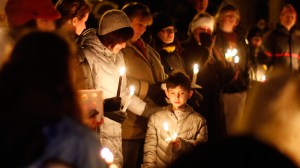
Sandy HookLast week our country was rocked by another mass shooting – this time at an elementary school.  Such events are becoming more and more common.  Many are pointing fingers at our country’s easy access to guns, lack of care for those with mental illness, culture of violence and even to the increasing secularization of our society.  While all of these things may be contributing factors, I suspect that the shootings and other acts of violence are symptoms of a deeper wound.  Even in an age where we have so many resources and access to so much information and so many ways to connect with one another on social media, there seems to be an increasing soul-emptiness that leads to despair, anger and isolation.  For all of our resources and access to information, we are increasingly distant from others and isolated from community.

In Community: The Structure of Belonging (Berrett-Koehler Publishers, 2008), author Peter Block makes the following statements:

without a willingness to be accountable for our part in creating a strong and connected community, our desire to reduce suffering and increase happiness in the world becomes infinitely more difficult to fulfill. (p ix)

A community’s well-being simply had to do with the quality of the relationships, the cohesion that exists among its citizens. (p. 5, citing Robert Putnam’s findings in the book Bowling Alone)

The solution for our spiritual dis-ease will not be found by discovering more information, making more FB postings, or generating more programs.  Instead, I would suggest that investing in relationships and generative community would be more productive healing tools.

It has been noted that because God so loved the world that He didn’t send a committee; an email, a tweet, or even a Hallmark greeting card… instead, God came in person to dwell among us.  The first Christmas present was the gift of presence.  In Christ, the world experienced the presence of God and God’s love.  And by the Spirit, the gift of His presence continues with us.  Presence is the gift that moves us from knowing about God to knowing God and experiencing God’s transforming love.   

If you think about it, the gifts that God gives to us to share with others are also gifts of presence.  That is to say, the gifts of healing, prophecy, exhortation, etc. are all gifts that can only be given and received inter-personally.  They require presence and interaction to be exchanged.  The ministry of reconciliation needs face-to-face and person-to person encounters in order to come to fruition, and God has provided us with gifts suitable for that ministry.

So as we scramble to finish shopping for the gifts we will put under Christmas tree, I hope that we will all make a commitment to be more open to the gift of Christ’s presence with us and then to share our presence with others at this season and in the years ahead.

Those of you who know me know that I am speaking to myself here as much as to anyone else.  As an INTJ on the Myers-Briggs schema and a 5 on the Enneagram, I am among the least relational of people… and yet, I am convinced that open and healthy personal relationships are one key way that God works in and through us to generate a blessed spiritual and communal life.

May God grant us (especially me) the courage and strength to risk being Christmas presence.

Giving Thanks Amidst the Rubble

“Give thanks in all circumstances; for this is the will of God in Christ Jesus for you.”   1 Thessalonians 5.18

Years ago, I played the role of Sarah (the wife) in  “JB,” a play  based on the Biblical book of Job, written (in verse) by Archibald McLeish.  In this play, as in many other works of literature , those who suffer the unimaginable and senseless tragedies of life question the goodness and/or existence of God.  One of the characters (Nickles) says:  “I heard upon his dry dung heap/that man cry out who cannot sleep:/ “If God is God He is not good,/ If God is good He is not God…”  JB (Job) wishes he had never been born.  Sarah encourages him to curse God and die.

As we prepare to celebrate Thanksgiving, I am struck by the difficult, tragic and painful circumstances of so many people here and around the world.  Some of my friends have lost loved ones to senseless accidents; mothers and fathers mourn sons and daughters lost to warfare; hundreds of thousands are trying to pick up the pieces of their lives after Hurricane Sandy; and countless others struggle with financial, emotional or physical difficulties.  In the midst of these times, Paul’s exhortation to “give thanks in all circumstances” seems almost cruel, and faith (at best) a challenge.

Perhaps in such times, we can only give thanks that God IS.  Though we struggle to give thanks for our circumstances, we can be grateful that there is One to whom we can cry out, “My God, my God, why hast Thou forsaken me?”  Even with that, often we must (like Christ) experience additional grief and endure the long darkness of the tomb before we begin to see the first rays of Easter morning.

Near the end of JB, Sarah has left JB and her home, turning her back on God and faith.  But as in scripture, she eventually returns.  Here she tells JB about  her journey out into hopeless doubt and back again:  “Among the ashes./All there is now of the town is ashes./Mountains of ashes.  Shattered glass./Glittering cliffs of glass all shattered/Steeper than a cat could climb/if there were cats still…/And the pigeons –/They wheel and settle and whirl off/Wheeling and almost settling…/and the silence–/There is no sound there now — no wind sound–/Nothing that could sound the wind–/Could make it sing — no door — no doorway…/only this  [she holds a budding forsythia twig in her hands]  Among the ashes!/I found it growing in the ashes,/Gold, as though it did not know….”

Amidst the ruble and ashes, a small twig brings a bit of hope and courage.

My prayer for those who are suffering much this Thanksgiving is that they manage to give thanks that God IS and that they discover the forsythia in the ashes, either through the beauty of nature or the generosity of others.

If the only prayer you say in your life is ‘thank you,’ that would suffice.

– Meister Eckhart

Dummies and Other People

Or, how I spent my summer vacation…

As many of you know, my husband is a retired magician and entertainer.  As an off-shoot of his professional work, he owns a company that makes puppets, which we sell at fairs, conventions, etc.. And so it is that we recently found ourselves at a Ventriloquist Convention near Cincinnati, OH.

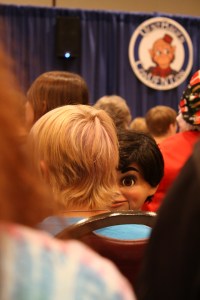
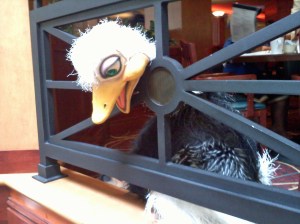
In some ways, it was radically different than my daily context.  People were walking around with Dummies (aka Vent Figures or Puppets) and talking in strange voices.  There were at least five Santa Clauses in the group, and at least one Mrs. Clause.  The venue needed more chairs than there were people, because sometimes even dummies need a chair of their own (but not always… see photo at right).

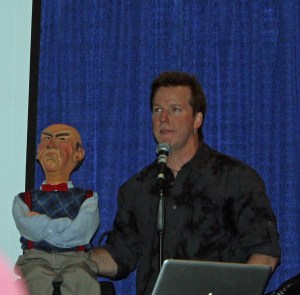
There were also some similarities to my usual world of church.  There were people of all ages (from 7 or so to 90+), though (sadly) they were mostly white.   I listened to one performer talking to another and noting that shifts in American culture (especially social media) were making him speed up his timing and shorten the duration of his performances.  (Sound familiar pastors and worship planners?)  One performer who came out of retirement to do a performance for the convention told of how he had to go back to the gym because he needed weight training to be strong enough to hold up the dummy and his fingers needed to be nimble enough to work the mechanisms.  When Jeff Dunham did his lecture, he talked about the

Ostrich dummy takes a break.

challenges of keeping your work fresh, lively and contemporary, and the ethical challenges of humor and self-revelation.

Some of the deep joys I experienced included not only wonderful performances by Taylor Mason, Sammy King, Nina Conti, Dan Horn and Jeff Dunham, but also observing some incredible moments of generosity — experienced vents and performers were so willing to share tips with beginners, and even to sit with them and coach them.   Though there were many professionals among the group, there was also a large percentage of people who do ventriloquism for a hobby.  As I spoke with some of these hobbyists, I discovered that most of them performed in venues like hospital children’s wards or worked with special needs children and/or the aged.  Their eyes lit up as they described how blessed they were to be able to bring joy and laughter to the ones they perform for.
So even though I didn’t do anything particularly Presbyterian on my vacation, there were still plenty of “God Things” to bless the time away.   Hallelujah!

Jeff Dunham and Walter Give a Lecture

Rejoice With Me!

I celebrated the Thanksgiving of 2007 in Ghana, at the tail end of a two week mission trip with Presbyterian friends from Chicago and Bainbridge Island (Washington).  We had been working with a school and hospital in the small town of Kasei (or Kase) in the far northeast of the Ashanti Region beyond the town of Ejura.

While there, we became acquainted with one of the teachers, Seth Owusu Koranteng, who also served as Clerk for the Kasei New Church Development of the Presbyterian Church of Ghana (“PCG”).  During the week, Seth introduced me to Rev. Osei Kofi, the District Minister for that area (Ejura region).  As a result, I was invited to preach at the new church that Sunday since they had no regular ordained minister.  The service of worship was a joyful celebration of God’s grace and mercy shown to us in Christ Jesus.  (BTW, you can experience that same kind of joyful worship if you visit the Ghanaian congregation in Cherokee Presbytery!)

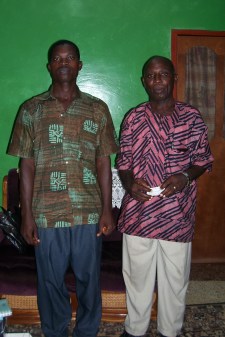
Seth and Rev. Kofi
Seth translated for me during worship and served as liturgist

As the week progressed, I learned that Seth was hoping to enter seminary and prepare for ordination in the PCG.  He was preparing to take the exams required for one to be granted entry into the seminary… I looked at them and WOW!  The exams to enter the process in Ghana are almost as difficult as the ones we take at the conclusion of our preparation process in this country!

After I flew home, Seth and I continued to correspond via email and snail mail.  He shared with me his marriage to the beautiful Dorothy and then the blessing of the birth of their son, Benedict.  And he kept me up to date on his seminary studies, while I kept him up to date on my journey of faith and vocation.  The commitment to preparation for ministry required a lot of sacrifices for Seth and for his family.  He had to relocate to Accra during the school year, leaving Dorothy and Benedict in Kasei.  He would return to Kasei between school years to work and to be with his family.  All this, plus the cost of seminary and the hard study that the ministry requires.

And so it is with great joy that I received an email from him this last week telling me that he has completed his studies and has now been commissioned to preach and administer the Sacraments in Kasei.  [The PCG system is a bit different than ours.  Once you have completed seminary, the seminary commends you to the Church as fully trained for the Ministry.  The Church will then Commission and Appoint you to Preach and Administer the Sacraments for two years serving as Probationer, after which the Church will Ordain you (provided you have behaved and served well).  It is the Church that appoints ministers to individual congregations — no call system like ours.] Our mutual friends and siblings in Christ, Lois and Jerry Andrews, were able to be there with him to celebrate the big day in person.

And so, I now share this wonderful act of God with all of you.  It is such a gift to have friends around the world who share our love of Christ and commitment to the Gospel.  It is also wonderful that we live in an age when we can communicate almost in real time through the internet, and share thoughts, picture and so on.

Seth, congratulations on your commissioning.  May God bless you, Dorothy and Benedict (and other children yet to come?) in your work for the Kingdom of God in Kasei.  I’m so proud of you and so happy to call you my friend!

Jerry and Lois Andrews with Seth Owusu Koranteng, Dorothy and Benedict, 2012

I ♥ the PC(USA)

I the PC(USA)

I did not grow up in the Presbyterian Church.  My family belonged to the Church of Christ (of the early 19thcentury Restoration movements).  One of the good things I received from that denomination was knowledge of scripture.   They taught me to read the Bible… and I did… and so when what I read there was not in congruence with what the church taught, I felt I could no longer stay in that denomination.  After a few years on my own, I began to hunger for a faith community again, and decided to risk testing the notion that the Church of Christ did not have a lock on God.   Eventually, I wandered into a Presbyterian Church (a Charismatic one at that) and found my new home there.

Since then, I’ve discovered that even the PC(USA) is not perfect.  I guess no denomination is.  But this is my faith home, and despite its imperfections, I love the PC(USA).

As we approach the next meeting of the General Assembly, many are worried about our denomination and the proposals that may come from the Assembly.   And so I thought that perhaps this was a good time to share the things that I love about our denomination and why I stay despite some decisions that I disagree with:

  1.  We think that Theology Matters.  By this I do not mean that there is only one correct theology, but that we value the life of the mind and engage scripture with our minds, seeking to understand it as a whole as well as in its individual parts.
  2. For us (or at least it seems so to me), the Living Word interprets the Written Word, not the other way around.  Just as the first disciples’ experience with the Living Word caused them to radically reform their understanding of the Hebrew Scriptures, so we are constantly being reformed in our understanding of Scripture as we encounter the Lord who lives in the world and among us.  For me, this is what distinguishes a confessional church (like the PCUSA) from a dogmatic church.
  3. We dare to speak truth to power and to challenge injustice.  I am proud to be part of a denomination that stood up for civil rights, that spoke against corrupt governments in Central America (even taking our own government to task), that spoke against Apartheid in South Africa and that even now stands with those at home and abroad that experience injustice and oppression.
  4. We are connectional and ecumenical.  Our congregations are connected to one another organizationally and accountability-wise, but also organically and relationally.  We are partners in the Kingdom of God. Cherokee Presbytery’s vision statement that was adopted in 2008 highlights the call of God on our lives to be – all of us together – the body of Christ, and to live into this in new ways and to be about ‘one another-ing’ in ways that we haven’t previously.
  5. We are allowed to work for change, even while we must live with decisions we object to.  The first confirmation class I ever taught was during the time that the “Fidelity and Chastity” provision was added to the Constitution.  As I was discussing this with the young people, a mutiny erupted.  They decided that they did NOT want to join the church… they did not want to belong to any denomination that imposed what they saw as narrow and non-Christ like rules.  I shared with them that often the church made decisions that I did not find to be consistent with my sense of scripture, but one of the things I liked about the PC(USA) was the fact that I am granted the right of conscience and can work for change… we do not have an individual that makes decisions for us, but instead we work together to continue to discern God’s wisdom for the church.  They thought about it for a while, and finally decided that they could commit to this kind of denomination.
  6. We don’t have to all agree.  My family of origin did not do disagreement well, so one of the joyful discoveries of being in the PC(USA) is that I can love and be loved back by people who do not agree with me on things.  My life and faith have been deeply blessed by conversations and debates with my Presbyterian brothers and sisters… I’ve even been known to change my mind on some things!

So there you have it… a few of the reasons I love this denomination.  These are the things I hold on to when the waters get choppy.  What about you?  Why do you love the PC(USA)?