Walking in the Shadows of Dementia

Last week, I shared some personal news with my Presbytery colleagues that relates to an imminent transition for me and my family.
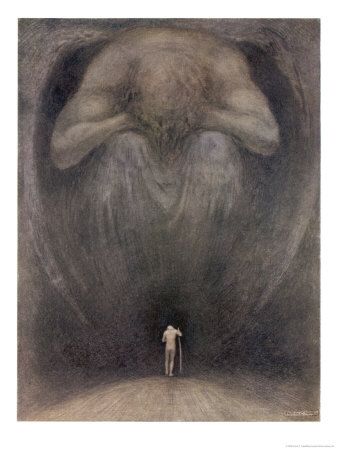
frank-c-pape-yea-though-i-walk-through-the-valley-of-the-shadow-of-death-i-will-fear-no-evil

Over two years ago, my beloved husband was diagnosed with Dementia/Alzheimer’s.  Sadly, it has now come to the point that in order to provide for his safety and well-being, I am looking for different living arrangements for us… he will likely wind up in a memory care unit, and I in some smaller apartment.

It’s been an interesting journey… sometimes funny, sometimes crushingly sad, and sometimes simply overwhelming.  At this point, he no longer knows who I am, though he is still willing to trust me with most things.  Many of his unique capabilities and skills are gone.  However, his personality is largely intact:   he is still the funny, sweet, kind, compassionate and jolly old elf that he has always been.  For this I am grateful.

Learning to live with Alzheimer’s is a shadow dance of funny and sad moments, confusion and clarity, deep remembering and” new” discoveries.  I am confident that my Beloved is in God’s good care, and that all will work out well for both of us in God’s larger economy.

This is also an emotional and spiritual journey that is stretching me in many ways.   I am having to learn numerous things (mostly things I’d hoped to postpone indefinitely).  I will likely start another blog to detail my/our journey with Alzheimer’s, but here is the cliff’s notes edition of the journey thus far:

  • Patience — Those of you who know me know that I am NOT a patient person and I’m mostly ok with that… but apparently, God is not.  I have to learn to walk, talk, and live at a slower pace and to bear with the many repetitions of the same question.
  • Moving from the balcony onto the dance floor:  I am a person who lives on the balcony… I prefer to be somewhat removed from the action so that I can see the big picture and make assessments.  The Dementia Dance has thrown me from the balcony onto the dance floor… I am now awash in the hands-on details of daily life.  I have been pushed out of my theoretical and cerebral comfort zone into the all-to-physical and present dance floor of dementia —  from my head to my hands and heart; from living in the future to living in the moment (if not in the nano-second); and from theory to practice.  I am learning about incarnational mission.
  • The shape of hope is changing.  I used to have two kinds of hope:  one eternal and one temporal.  Now,  hope is found more at the intersection of these.  Each day, I pray that a bit of joy, a moment of grace, or a brief experience of shalom will come for both my husband and myself.  Watchful and expectant awareness is required in order to keep from missing God’s provision of this daily bread.  It means adopting a year-round Advent posture, if you will.
  • Moral fuzziness… what exactly does the way of the cross look like in this situation?  Many people are encouraging me to preserve myself and my assets so that I can have a future.  But all that seems at odds to the One who said “those who seek to save their lives will lose them.”  I keep hearing the lyrics to “Without Running Away” by Jason Gray in my head.  This is most certainly proving to be a discipleship challenge for me.

And finally, I have a renewed gratitude and appreciation for my friends and colleagues that surround us during this time.  You are God’s very special gifts to us… thank you for being there.  I treasure your prayers.

Psalm 23

The Lord is my shepherd; I shall not want.
He maketh me to lie down in green pastures: he leadeth me beside the still waters.
He restoreth my soul: he leadeth me in the paths of righteousness for his name’s sake.
Yea, though I walk through the valley of the shadow of death, I will fear no evil: for thou art with me; thy rod and thy staff they comfort me.
Thou preparest a table before me in the presence of mine enemies: thou anointest my head with oil; my cup runneth over.
Surely goodness and mercy shall follow me all the days of my life: and I will dwell in the house of the Lord for ever.

Artwork by Frank C. Pape

Racial Profiling and Me

It’s been interesting to hear the variety of responses to President Obama’s comments yesterday about race in America.  I was very proud to hear our President speak about the issue and to bring to America’s living room the all-too-frequent realities faced by our African-American brothers in particular.  

 Since his speech, many people have responded that they, too, feel profiled or treated differently.  A white male on CNN today talked about how a woman alone might respond to his entry into an elevator by clutching her purse in fear.  “Would that constitute racial profiling?”  he asked.  

 All this made me remember when I first moved to LA (that’s Los Angeles, not Lower Alabama!).  I was horrified to find myself doing all of the things that President Obama was talking about… I clutched my purse, I locked my car doors, I crossed to the other side of the road and so on.  I did this when I encountered people of other color… African Americans, Latinos, etc.  Oh, no…. how could I?  I never thought of myself as a racist… and yet, here I was, acting like one. 

 Over time, I took note of my reactions to people, and I discovered something:  My fear response was based on my perceived commonality with others.  I was less fearful of a woman of any color than any man… even a white man.  I then realized that even with men, my reaction would be based on perceived commonalities/differences.  A man in a business suit would prompt a different reaction than a guy in jeans and a tie-dye t-shirt. 

All this to say, in the words of a song in the Broadway show, “Avenue Q,” everyone’s a little bit racist/class-ist/sexist/discriminatory.  Sad, but true.  And it’s not supposed to be that way. 

I guess we fear others partially because we lose sight of our common humanity and the fact that we are all made in God’s image, but I think the largest reason is because as fallen, broken people, we live in captivity to fear.  Christ has come so that we might be liberated from all of our fears, and freed to live and love with arms open wide.  But so often, we fall back into the toxic pool of fright. 


As we engage in the “soul searching” that President Obama asked us to do, let us recommit ourselves to living in the light of Christ as people with nothing to fear.  As the Apostle Paul reminds us in Romans:

 What then are we to say about these things? If God is for us, who is against us? He who did not withhold his own Son, but gave him up for all of us, will he not with him also give us everything else? Who will bring any charge against God’s elect? It is God who justifies. Who is to condemn? It is Christ Jesus, who died, yes, who was raised, who is at the right hand of God, who indeed intercedes for us. Who will separate us from the love of Christ? Will hardship, or distress, or persecution, or famine, or nakedness, or peril, or sword? As it is written,
‘For your sake we are being killed all day long;
   we are accounted as sheep to be slaughtered.’ 
No, in all these things we are more than conquerors through him who loved us. For I am convinced that neither death, nor life, nor angels, nor rulers, nor things present, nor things to come, nor powers, nor height, nor depth, nor anything else in all creation, will be able to separate us from the love of God in Christ Jesus our Lord. 

Something to Think About

We in the west are so used to thinking of ourselves as mission-senders, that it is hard for us to conceive of being on the receiving end of mission. And yet, with the growth of Christianity in the global south and east, and with the growing immigrant population in the US, we have the opportunity to receive much from our Christian brothers and sisters from other lands. And who knows but that “they” might have some good ideas for us to explore!

A case in point – when I was on Presbytery staff in Philadelphia, we had a Ghanaian pastor who spoke to me about his work when he was in his home country. There, he was pastor for 20 (yes, twenty!) villages. He said that he would travel to each village once a month to preach, administer the sacraments and visit. Then, he said, “the next day, I would walk to the next village to minister there.” When I asked him who took care of the people between his visits, he told me that the church elders of the village were responsible. I then inquired how he ensure that the elders’ teaching and leadership were theologically sound and practically solid when he was not there to observe. He told me that once a month, all of the elders came from their various villages to where he was — and there, he would teach them theology, talk about their preaching ministry, etc.

Ever since this conversation, I’ve kept this model in my mind, thinking that it might offer something for the PCUSA. What would happen if we took our ruling elders seriously as spiritual leaders, trusting the day to day ministry, and nurture of the community to them? What if teaching elders became more responsible for teaching and equipping the ruling elders for their ministry? I truly think that this model is one that our Presbytery might explore, particularly in areas where we have many smaller congregations that still have vital ministry and ripe mission fields, and yet cannot afford full-time pastors of their own.

Are there ideas you have encountered from the larger Presbyterian family that we might think about?  What are the opportunities and risks entailed?

Photo Source:  http://25.media.tumblr.com/tumblr_lxt54dAsuc1qzx8p9o1_500.jpg

Gateways

When I was younger (just a few years ago!), people used to talk about ‘gateway drugs’.  According to Wikipedia, “The gateway drug theory …  is the theory that the use of less deleterious drugs may lead to a future risk of using more dangerous hard drugs and/or crime. It is often attributed to the use of one of several drugs, including tobacco, alcohol, and cannabis.”

I think that this theory could be applied in a positive sense.  Some practices are  gateways for good; practices that create entry points for the Spirit of God to change peoples and cultures.  I have had the opportunity to work with people in countries (sometimes including our own!)  where the dominate version is contrary to the gospel version.  There are so many places where greed, ambition, injustice, oppression, suppression and idolatry hold sway. Given that we are a people of “sub-version” (thank you, Walter Brueggemann), I like to think about what things we can offer to or encourage in the world that create space for the Spirit to be at work in a people and a culture in a way that can subvert the ways of the world and give birth to the Kingdom of God.  How can we offer or teach something that is not so tainted by our culture that it does a disservice to the gospel in the lives of our neighbors ?

Over the course of time,  I’ve come to the conclusion that the most subversive radical, revolutionary things we can do as people in mission… the best things we can do to pave the way for the Spirit to work in the hearts and culture of people are:

#1:  Teach People to Read

Becky and Bear 2Being able to read allows someone to learn for themselves and not be held captive to the propaganda or agenda of others.  As a good protestant, of course, I think that the ability to read scripture for oneself is of utmost importance.  (What more transforming book could one read than the Bible?)  Additionally, the ability to read means that a person can continue to expand their horizons without ever physically leaving home; and  can encounter new ideas from other people and places — and if that’s not subversive/dangerous, I don’t know what is.

“It is what you read when you don’t have to that determines what you will be when you can’t help it.” ― Oscar Wilde
“You don’t have to burn books to destroy a culture. Just get people to stop reading them.” ― Ray Bradbury

 “Wherever books are burned, human beings are destined to be burned too.” – Heinrich Heine

#2:  Help People Learn to Pray

prayingPrayer brings the stuff of scripture off of the page and into our hearts. Whether our prayers consist of speaking to God, listening to God, interceding for others, or simply resting/dwelling in God, it is here that the Kingdom is formed within us and in the world around us.

 “God shapes the world by prayer. The more prayer there is in the world the better the world will be, the mightier the forces of against evil …” – E.M. Bounds

“The function of prayer is not to influence God, but rather to change the nature of the one who prays.”  – S. Kierkegaard


#3:  Show People how to Serve One Another

nursingAt first, I was tempted to title this point “teach people to serve” or to “serve others” but this way of looking at our incarnational mission task would imply a one-way action… and we’ve had enough of that in the history of Christian mission.  Besides, such a model would not honor our Lord, who came to serve others but also received from them (an anointing from Mary, service from his disciples and a mission-expanding lesson from the Syro-phonetician Woman).  Jesus tells us to serve our neighbor, and later tells us to love one another.  We all are neighbor to someone, so learning to serve one another seems consistent with both the actions and words of Christ.  Learning to serve one another keeps the emphasis on a posture of giving and receiving (or as some would say, evangelizing and being evangelized).

“For it is in giving that we receive.”― St. Francis of Assisi

gateway

Reading, prayer and serving one another…these are my three “gateway drugs” for discipleship — openings for the work of the Holy Spirit.  What are yours?

Getting in the Game

budAnd the day came when the risk to remain tight in a bud was more painful than the risk it took to blossom.  ~ Anais Nin

This last Saturday, I joined with others in our Synod for a Get in the Game:  1001 New Worshiping Communities event.  Vera White (GA associate for the initiative) introduced us to a number of ways in which people have begun to embody the call to make new disciples.  Each one was remarkable for its creativity, and its contextual-relational witness to the gospel.  At the end of the day, I was energized and excited with the possibilities.

I won’t go into all of the marvelous detail (you can link to the 1001 website for some of that), but I will share four thoughts/learnings that I took away from the day:

1.  Everyone has a role to play:  Part of the invitation for each of us was to listen to what God is doing in and through this initiative and try to discern whether God is calling us to be SENT orto be a SENDER.  In other words, some of us may be called go and do a new thing, while others of us asked to make room for, nurture and support that new thing.  Given that most of the SENT work is more suited to young folks, many of us will not feel the call to go, but we can still take part as SENDERS, by opening our hearts, our minds, our communities and our procedures to make way for the new things that God is doing in and through the faith community.

2.  No more paint-by-number:  This is a time for great creativity and flexibility; a time to color outside the lines as we try new ways to be and do church.  It is no wonder that many of the 1001 New Worshiping Communities are deeply engaged with the arts.

3.  Contextual and Relational is where it’s at.  It’s not about build-it-and-they-will-come.  It’s not about luring people into our existing churches.  Instead, it is about creating new places in the neighborhood where people can connect… where  genuine neighborliness and community can take shape.  It’s about actively serving and changing the local context from within that context.  New worshiping communities arise from or walk alongside these more “secular” communities.  In this work, and by the ministry of the Holy Spirit, neighborhoods, communities, people and the church are being transformed.  I’ve been known to say that New Church Developments are NOT the root of evangelism, but are instead the FRUIT of evangelism.  This seems to be the paradigm that is behind the 1001 Initiative.

4.  Discernment, not decision-making:  This work is deeply shaped by prayer and spiritual practices.  It is less driven by demographics and target markets than it is drawn together by the Holy Spirit’s tugging at the heart strings of those involved.  Since it is not driven by demographics that seek a target market that has great affinity for the Presbyterian Church (educated, powerful, well-to-do, white-collar), we are discovering some of our idols and re-discovering some of the jewels in the Presbyterian & Reformed storehouse.

In parting, Vera left us with some questions to ponder as we seek to answer the question of whether we are being called to being SENT or SENDERS.  I’ll leave share them here for your contemplation.

How do we:

  • create a culture of innovation

  • listen to voices on the margin

  • explore new ways of being church

  • move from regulatory to permission giving ways of working

  • embrace our diversity

  • invite new conversations

As always, I welcome your comments, thoughts, and reflections.