2The word that Isaiah son of Amoz saw concerning Judah and Jerusalem. 2In days to come the mountain of the Lord’s house shall be established as the highest of the mountains, and shall be raised above the hills; all the nations shall stream to it. 3Many peoples shall come and say, “Come, let us go up to the mountain of the Lord, to the house of the God of Jacob; that he may teach us his ways and that we may walk in his paths.” For out of Zion shall go forth instruction, and the word of the Lord from Jerusalem
Broad Street Ministries in Philadelphia, truly a mountain of the Lord where people come in to learn and go forth in instruction. A sign, instrument and foretaste of the Kingdom of God. http://broadstreetministry.org/
The full light of God is so bright that it is hard for us to take, much like looking straight into the sun. But, when the Kingdom Comes in its fullness, we will be in the un-mediated presence of the Trinity. We will see the face of God in all its blazing brightness. We will be in the presence of All That Is Real.
Most of us instinctively know that we cannot bear this much reality, this much beauty; that we cannot see the face of God and live. I am reminded of C. S. Lewis’ description of heaven in The Great Divorce where even heaven’s grass is so real that it hurts the feet those who are not ready to participate in the Kingdom.
The Brightness of the Kingdom Fullness and our inability to bear it are also spoken of in the Jewish Mystic tradition of Kabbalah, and is intimately tied to God’s creative work in the world. (Note: Kabbalah holds that God made multiple worlds, and various other things with which I do not agree, but I do find much of the tradition to be very evocative and helpful to me as a Christian.) Below is an article by Tzvi Freeman describing something of this dynamic, which is called Tsimtsum (or creative withdrawal) — See Note 1 for a link to the entire article.
What Is Tsimtsum?
Presence Through Absence
If you were to create a world, the first thing you would need to master is tsimtsum. Tsimtsum is a way of being present in your absence. ….
Tsimtsum literally means “reduction.” For a Kabbalist, a tsimtsum is a reduction of the divine energy that creates worlds—something like the transformers that reduce the voltage of the electric current leaving the turbine generators, until it’s weak enough for a standard light bulb to handle. So too, the divine energy needs to be stepped down so that the created worlds can handle it.
… Existence requires some sort of connection to the initial source of everything—meaning, to the Creator.
[There is a] type of tsimtsum, described by the master Kabbalist, Rabbi Isaac Luria, known as “the Ari.” It is the primal tsimtsum, and it is unique from all other tsimtsumim.
Much like the irrational number pi, the primal tsimtsum transforms an infinite circle into a measured line. The Ari described an initial, pre-creation state of infinite light, within which there was no place for anything at all to be. Before creating any worlds, the Creator withdrew that energy completely, resulting in a total void within the infinite light. Only then did He extend into this void a metered line of light from the encompassing infinite light, with which He generated an innumerable series of worlds.
Tsimtsum, then, is the way G‑d makes space for us to have our own world. He hides His light from us, so that we can make our own choices. But He remains immanently present within that hiddenness. In a way, He is yet more present in His absence than in His presence.
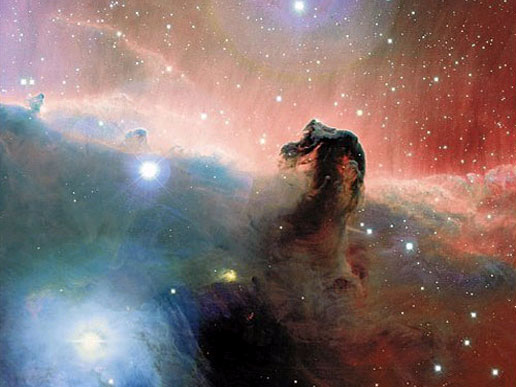
Hubble Photo, Section of M17 a “hotbed of star formation”
Christ the King Sunday and the weeks that follow are my favorite time in the Christian calendar. I love the way the lectionary moves progressively from the majesty of the Kingdom realized in its blazing fullness at Christ’s Second Coming to its humble beginning in the soft light of the manger. Each liturgical year, we take the journey from Fulfillment to Expectation and back to Fulfillment again: from light to darkness back to light again. It is a mobius strip of faith, moving us from one plane to another, drawing us deeper and deeper into the mystery and the presence of God-With-Us.
I had considered doing a photo-a-day project for Advent much as I did for Lent (see www.rethinkchurch.org ) but have decided to do something a bit different instead. Over the course of these next six weeks, I will be posting scriptures, thoughts, photos, poems, etc. on the journey from promise realized to the nativity to Epiphany, using the notion of the changing light and these themes:
Week One~ The Kingdom Comes in its Fullness
Week Two ~ The Vision Beckons
Week Three ~ Hope of the Anawim[i]
Week 4 ~ The Promise Remembered
Week 5 (Christmas Week) ~ The Promise Hidden in Plain Sight
Week 6 ~ Epiphanies
I invite each of you to follow along and contribute your own thoughts, photos, poems, etc. by posting them on Cherokee Presbytery’s Facebook page. (If you’ve not “liked” the Cherokee Facebook page, you will need to do so before you can post anything.) I can’t wait to see what we all come up with.
[i] According to The New Jerome Biblical Commentary, anawim is a Hebrew term meaning “overwhelmed by want.”
A colleague of mine said that being Presbyterian has been a spiritual discipline for her, in that she has learned to live in obedience with decisions made by a majority that did not include her.
One of the things that congregations departing our denomination have noted is that there has been a shift in power over the last ten years or so in the PCUSA. The “progressive” part of the denomination has grown, and with that, the more traditional or “conservative” parts of the church no longer carry the day on votes of one sort or another. I suspect that one of the main drivers in the departure of some congregations is this loss of power and influence… it is hard to become the minority when you are used to being the majority.
On the other hand, those who are now in the majority face a challenge as well. They need to remember that they were once “aliens and strangers” and so remember to treat those who are now in the minority with dignity and respect. As the Son of Man said, “Do unto others as you would have them do unto you.” Or, as Buddha said, “Do not do to others as you would not want them to do to you.” Or, as the Native American tradition says, you can’t understand someone unless you “walk a mile in their moccasins.”
My prayer for our denomination is that the emerging majority will behave well, remembering that majority does not mean unanimity, and that our words and actions need to protect and care for those who are in the minority. It is what Jesus would do.



 Thoughts & Images from the Heart